Middle seat,
head still up.
Your head goes forward. You wake up, straighten it, and forty minutes later it happens again. It took me an embarrassingly long time to work out why.

The middle seat is the one where it gets obvious. On the aisle you can slump outward. At the window there is at least something cold and solid to fall against. In the middle you have two strangers’ shoulders and a headrest that ends about four inches too low, and there is nowhere for your head to go except down.
So you do the arithmetic in the dark. Six hours left. Four of them would be enough to function tomorrow. You close your eyes and wait to go under, and just as you get there, your head goes forward and you are awake.
You straighten up. You wedge the pillow tighter. You try the tray table, folded arms, the seat back. Forty minutes later it happens again. Somewhere over the ocean you stop trying and just sit there, drowsy but awake, waiting for the cabin lights.
I did that for years and I assumed it was me — that I was a bad sleeper, or too tall, or too wound up to switch off. Everyone else on the plane seemed to manage. I have since built a company around the reason that assumption was wrong, so read the rest knowing exactly what I am. The explanation still holds.
Or keep reading — the reasoning is the useful part
I had been buying the wrong thing for a decade.
Memory foam instead of beads. The expensive brand with the good reviews. A hood. An inflatable wedge that went under the chin and held my jaw shut all night.
Every one of them was more comfortable than the last, and not one changed the outcome. My head still went forward. I thought I was buying support. I was buying cushioning, which is a different product wearing the same shape.
That was the part I recognised. Not the discomfort — the repetition. It is not one bad moment, it is the same bad moment on a loop until the flight ends.
Someone explained it to me sideways.
It came up on a delayed flight, with a stranger in the next seat who worked in physical therapy. She was not selling anything and she was not talking about pillows. She was talking about what happens to muscle tone at the moment you fall asleep.
It drops. That is not a fault, it is the design — it is supposed to happen, and in a bed it does not matter, because your head is already resting on something. Sitting upright it is the exact instant your head has nothing underneath it.
So the failure was never stamina, or stress, or being a bad sleeper. The moment sleep arrives is the same moment the support disappears.
Researchers have measured the general version of this. Compared with a seat reclined flat, sleeping upright produced roughly 79% less REM sleep across six sleepers over four hours, and separate work on sleep fragmentation puts the threshold for restorative sleep at about five to ten unbroken minutes. Those studies describe sleeping upright in general. They were not run on this product, and I am not claiming they were.
Then I looked at the thing itself.
A U-shaped pillow wraps the back of your neck and both sides, and then it stops. There is a gap at the front. That gap is not a flaw anyone hid — it is simply what a U is.
And forward is where a sleeping head goes. So the pillow cannot catch anything until after the fall has already happened, and when it does catch you, it usually folds your chin down into your chest, which is its own kind of awake.


So we closed it.
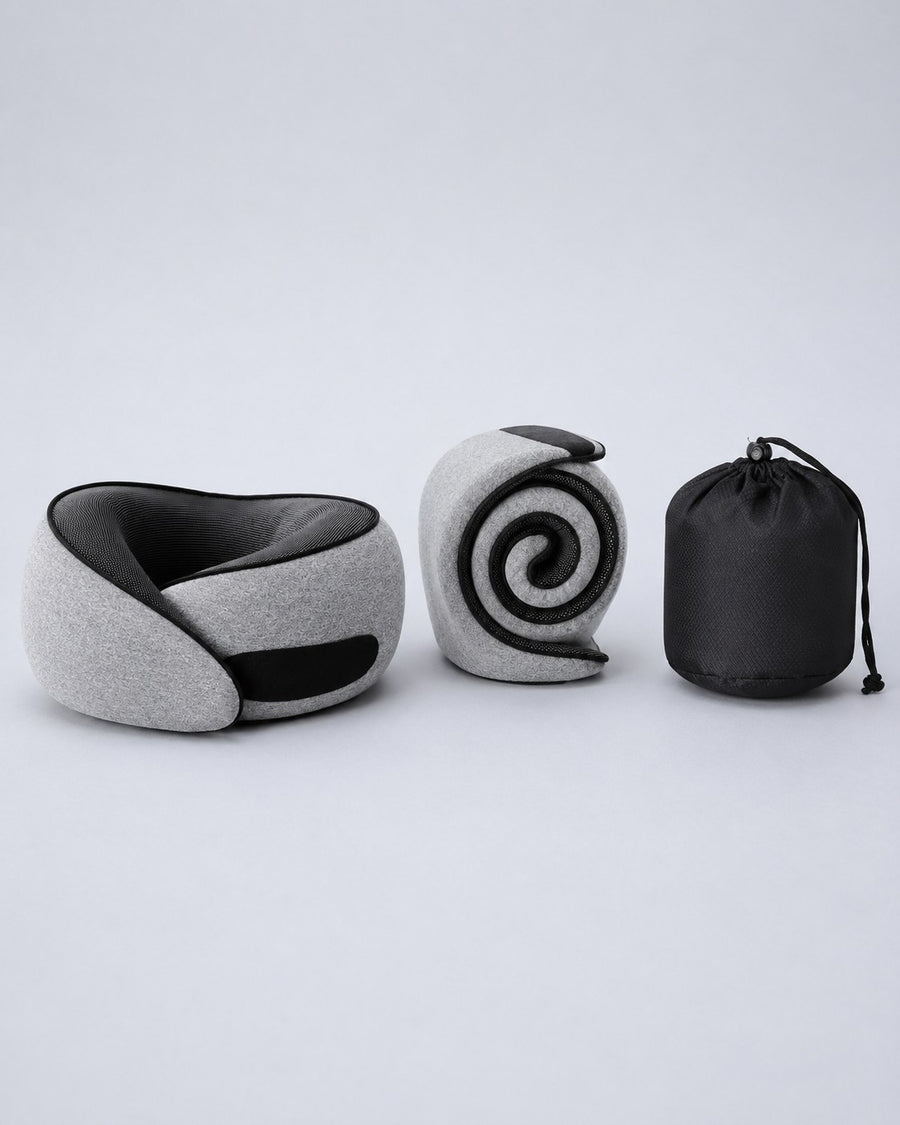
ROVE+ is a wrap rather than a U. The two ends cross past each other and fasten under the jaw, and the upper edge carries the weight. There is nowhere for your head to travel, which means your neck is not the thing doing the work. We call it the 360 Lock, which is a grand name for an ordinary idea: the front is shut.

And because it fastens to you rather than to the seat, the middle seat stops being the worst seat. Nothing to inflate, nothing clipped to the headrest. It behaves the same in 34B as it does at a window, which is the part I did not expect and the reason I stopped dreading the middle of the row.

Free carry case · free US shipping
What it actually is.
No reviews yet — we are new, and I would rather tell you that than borrow someone else’s. So here is the thing itself.
| Closure | Two ends cross and fasten, adjustable |
| Worn | 4.5″ tall, 7.8″–9.8″ across |
| Flat | 17″ end to end |
| Packed | 5.5″ cylinder, in its case |
| Weight | 16 oz |
| Fill | 100% memory foam, 5-second rebound |
| Cover | Removable, machine washable |
| Inner face | Breathable mesh panel |
| Cabin rules | Does not inflate, does not attach to the seat |
| In the box | Pillow and drawstring carry case |
| Shipping | Free US · ships in 1–2 days, arrives in 2–3 |
| Returns | 30 days · you cover return postage |
What I would tell you first.
Instead of borrowed credibility, the list of things about it that might annoy you.
- It runs warmer than a U‑shape. There is a breathable mesh panel against your neck, but there is simply more of it touching you.
- Over‑ear headphones fight the sides. Earbuds are fine.
- Some people feel it under the jaw. That is the mechanism doing its job, and on some jaw shapes it reads as pressure.
- It holds one position. If you shift around all night, that is the point of it, and it will not suit everyone.
- Getting it back into its case takes a firm roll and some patience.
- Memory foam has a smell for the first day. Leave it in a ventilated room and it goes.
Take it on one flight. If you land no better than you would have without it, email us within 30 days of delivery and we will refund you.
We send return instructions and you post the pillow back. Return postage is yours to cover. Once it reaches us we refund the full purchase price — not store credit.
I am not promising you will sleep. Plenty of people will not, for reasons a pillow cannot touch. I am promising that if the trip was not better, you do not pay for the pillow.
Free US shipping · ships in 1–2 days, arrives in 2–3